How to write a B2B case study buyers actually want to read
A practical guide to researching, structuring and writing a B2B case study with credible results, useful detail and a customer story buyers can trust.
Writing a case study has never been easier.
Writing one worth trusting may be harder than ever.
Give an AI tool a project summary and it can produce a perfectly respectable challenge–solution–results page before you have finished making coffee. But there is a high chance it will make your work sound exactly like everybody else’s.
One could argue that this makes case studies obsolete.
I, on the other hand, would argue that this fast production makes generic case studies obsolete. Here is why.
Buyers are already using AI to help them evaluate vendors. 6sense’s 2025 study of nearly 4,000 B2B buyers found that 94% used large language models during the buying process, mainly in the middle of the journey to compare offerings and synthesise information. Yet buyers are not simply accepting the summary and wandering off. In TrustRadius’s 2025 buyer research, 90% of buyers who encountered Google’s AI Overviews clicked through to the cited sources to check what they had read.
That makes original evidence more valuable, not less. A named customer, a documented starting point, a clear method, defensible results and a candid explanation of what happened give buyers something to inspect. They also give search engines and AI systems useful source material to understand and potentially surface.
So these days, a case study is not another story to publish because the content calendar says so. It is our evidence infrastructure: something a buyer can evaluate, a sales team can share and an AI tool can summarise without having to guess what you actually did.
But, unfortunately, most B2B case studies are written backwards.
The company starts with what it wants to say about itself, adds a customer quote for credibility, then goes looking for a result to place in the headline.
Buyers need the opposite. They need to understand what changed, for whom, by how much and how it happened.
A good B2B case study is a documented account of this transformation. It combines evidence, explanation and the customer’s perspective so that another buyer can judge whether the same approach might work for them.
Yes, that sounds simple. But deceptively so.
Writing a case study is not merely a writing task. It is a small research project involving customer selection, interviews, data, attribution, permissions, editorial judgement, design and internal politics. Then, once everyone has approved it, somebody will probably ask if you can “just make it a bit punchier”.
I write, on average, one case study a week on behalf of clients across different industries. These case studies frequently become some of the most visited pages on my clients’ websites. Case studies about my own work have helped me win clients too.
That’s why I tend to get a bit sad when I see a poorly written case study, especially when the evidence is strong.
So I decided to prepare this hopefully detailed guide that walks you through everything you need to have in place and take care of when you are writing a case study. Among many many other things, this article will show you:
take away 1
take away 2
take away 3
But first, let’s check why this guide really matters.
Why are B2B case studies so important?
Case studies matter because they help buyers reduce risk. Your product page explains what you offer. A case study shows that it worked in circumstances the buyer can recognize.
Their value is especially clear in the middle of the buying journey. In Demand Gen Report’s 2024 Content Preferences Benchmark Survey, 78% of respondents selected case studies as valuable during the middle stage, above webinars, analyst reports and user reviews.
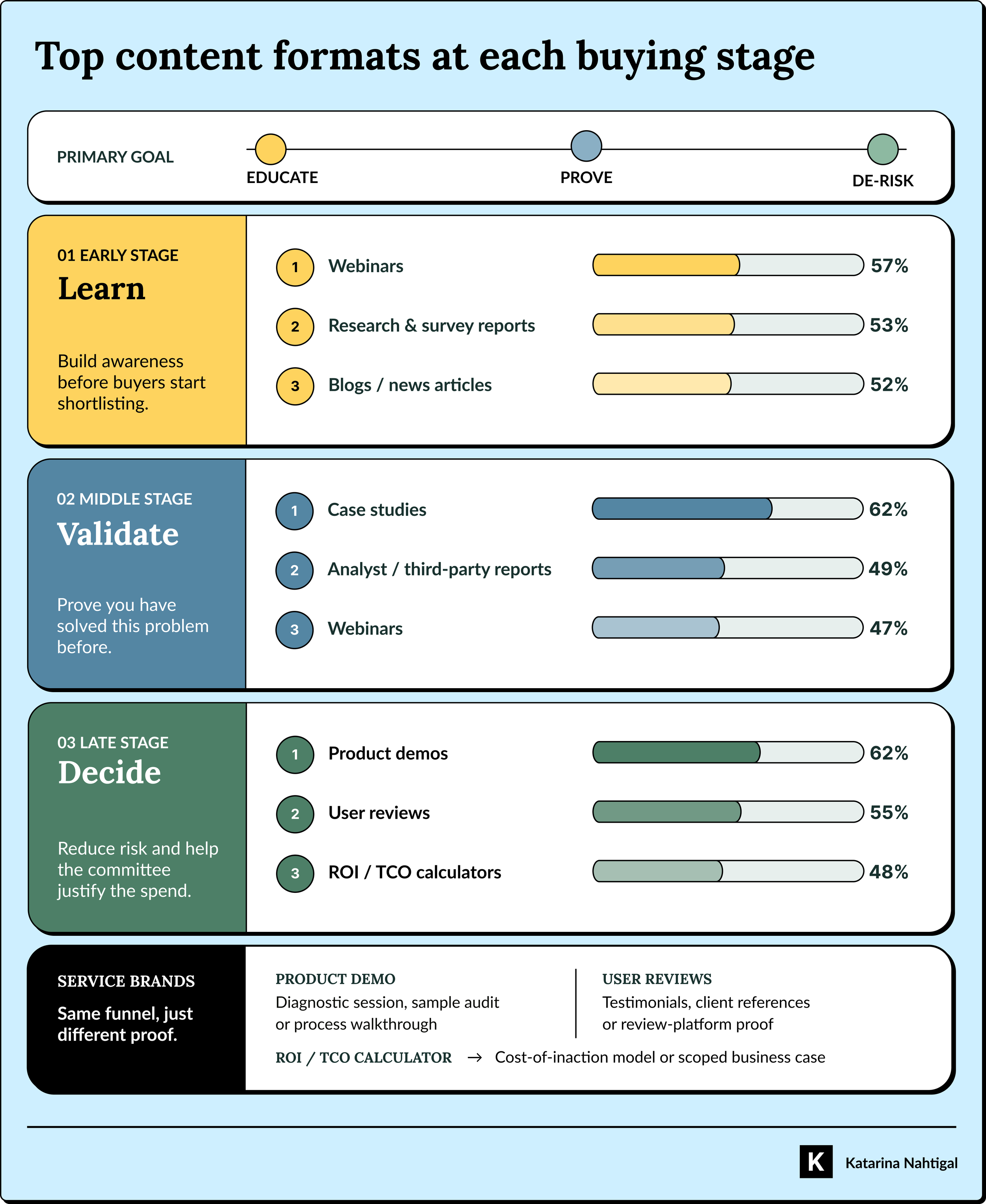
The best format changes as buyers move from learning, to validating, to making the final business case. At each stage, your content has a different goal.
A case study is not supposed to do every marketing job. Its particular strength is helping a buyer think: They solved a recognizable version of my problem. I can take this evidence to the rest of the team.
Marketers see the value too. In the Content Marketing Institute’s 2025 B2B research, 53% of B2B marketers named case studies and customer stories among the content types producing the best results, second only to video.
But the numbers only explain part of their usefulness. A strong case study also lets you:
employ a respected business as a credible vehicle for your message;
show how your product or service addressed a real operational problem;
avoid overclaiming by using a factual, proven example;
use the customer’s own words rather than polishing everything into corporate paste;
demonstrate your thinking and method, not only the finished result;
adapt one substantial story into sales material, social posts, presentations and proposals.
And there is one advantage marketers routinely overlook.
You get to interview someone with exactly the job title you are trying to reach.
Do not treat that conversation as a formality on the way to a testimonial. It is customer research. You can hear how they describe the original problem, what alternatives they considered, what nearly stopped the purchase, what they needed to prove internally and which results mattered enough to share.
That language can improve far more than the case study. It can sharpen your positioning, sales conversations, service pages and future content.
Why are so many case studies painfully dull?
Usually because they have been treated as an afterthought.
The project ends. Everyone moves on. Three months later, marketing receives a request to “turn it into a case study”, but nobody recorded the baseline, took screenshots, saved the audit or asked the customer what changed. The writer is left with a vague testimonial and several people insisting that the work was transformational.
A practical note: Try building case-study evidence into the project from the beginning. Your onboarding materials and pre-work intake forms should record the starting point: baseline metrics, current processes, known problems and expected outcomes. You may never turn that particular project into a case study, but if you do, you will have something more useful than everybody’s slightly different memory of what things looked like six months ago.
From there, case studies tend to go wrong in four predictable ways.
1. They are too slick.
Every difficulty disappears. The client is delighted. The process unfolds exactly as planned. The supplier appears quietly heroic.
It reads less like evidence and more like a hostage statement.
Buyers know real projects involve hesitation, constraints, trade-offs and wrong turns. Including those details does not weaken the story. It makes the eventual result more believable.
2. They are too long and boring.
Length is not the problem by itself. A long case study can work if each section helps the buyer understand the problem, method or result.
The real problem is poor information hierarchy. If the result is hidden in paragraph fourteen, the writer has made the buyer work too hard.
3. They look unfinished.
Low production value signals low importance. Inconsistent formatting, unreadable charts, generic stock images and unlabelled screenshots can make good work look questionable.
This does not mean every case study needs a cinematic launch. It needs enough care that the presentation supports the credibility of the evidence.
4. They are written for the vendor.
The vendor becomes the protagonist. Every section celebrates its expertise, proprietary framework and dedicated team.
Meanwhile, the customer—the person the buyer is trying to recognize—barely appears.
But enough of the self-righteous ranting. I cannot show you a single case study I have worked on that is not guilty of at least one of these problems. The point is not to achieve some immaculate case-study ideal. It is to notice where credibility and usefulness are being lost, then make better choices.
What should you do before writing a case study?
Do not open a blank document, or rather your favorite LLM just yet.
First, decide what evidence you need and whether the chosen project can provide it.
Maybe this is a bit controversial take, but IMO a famous client with a vague story is often more useful than a less recognisable client with a specific problem, accessible data and a candid spokesperson. The best content strategy, however, offers both types of stories.
Ideal process to build a case story looks something like this:
1. Choose the right customer and project.
Look for a project with:
a problem your target buyer will recognize;
a meaningful before-and-after contrast;
results you can verify;
a customer willing to be named;
a spokesperson close enough to the work to discuss the details;
a method that reveals something useful about how you think.
2. Agree on permissions early.
Before conducting the interview, establish what the customer is willing to approve. This can be their company name and logo and, in best cases, even distribution on their website, social channels and sales materials.
If approval only appears at the end, the most useful parts of the story may disappear during legal review. So gain some clarity before you start writing.
Anonymous case studies are sometimes unavoidable. They are also less persuasive because the reader cannot verify the customer or context. If the client cannot be named, make the process and evidence unusually specific, and be honest about what anonymity costs the story.
3. Collect the evidence before the interview.
Ask the account, delivery and customer-success teams for the material they already have, including the original brief or proposal, audit findings, screenshots, dashboards and process maps, etc.
This allows you to ask precise follow-up questions instead of spending the interview trying to reconstruct the entire project from memory.
4. Send a questionnaire, but do not replace the interview with it.
A questionnaire gives the customer time to check facts, find figures and think beyond their first answer. It also reveals which parts of the story need deeper exploration.
Mine is intentionally extensive. Some questions may feel random, but that is the point. The basic structure of a case study is predictable; the details that make one memorable are not.
In practice, I use two versions:
Before the call, I send the client a shorter questionnaire containing the most important questions: what made you seek our help, what were the results and how would you describe the collaboration.
This gives them time to check facts and find useful figures without confronting them with a small novel disguised as a form.During the call, I work through the longer questionnaire myself. The client is not expected to prepare an answer to every question; I use it as a prompt bank to explore the details, decisions and unexpected turns that make their story specific. Some of my favorite questions are:
If this project were a book or a movie, what would its title be and why?
What’s the most unexpected impact this project had?
How would this project be described by someone from a completely different industry?
Download the customer case study questionnaire →
Use the long questionnaire as a guide, not as a script for a written interrogation. The interview is where you ask, “What do you mean by that?”, “Why did it matter?” and “What happened next?” until the generic answer becomes a useful one.
How should you structure a B2B case study?
Use an inverted pyramid: lead with the information the buyer needs most, then add context, explanation and nuance.
Within 30 seconds, a reader should be able to identify the customer, the problem, the result and the broad method. If they must read the entire page to understand why it matters, the structure is working against you.
Here is the structure I use.
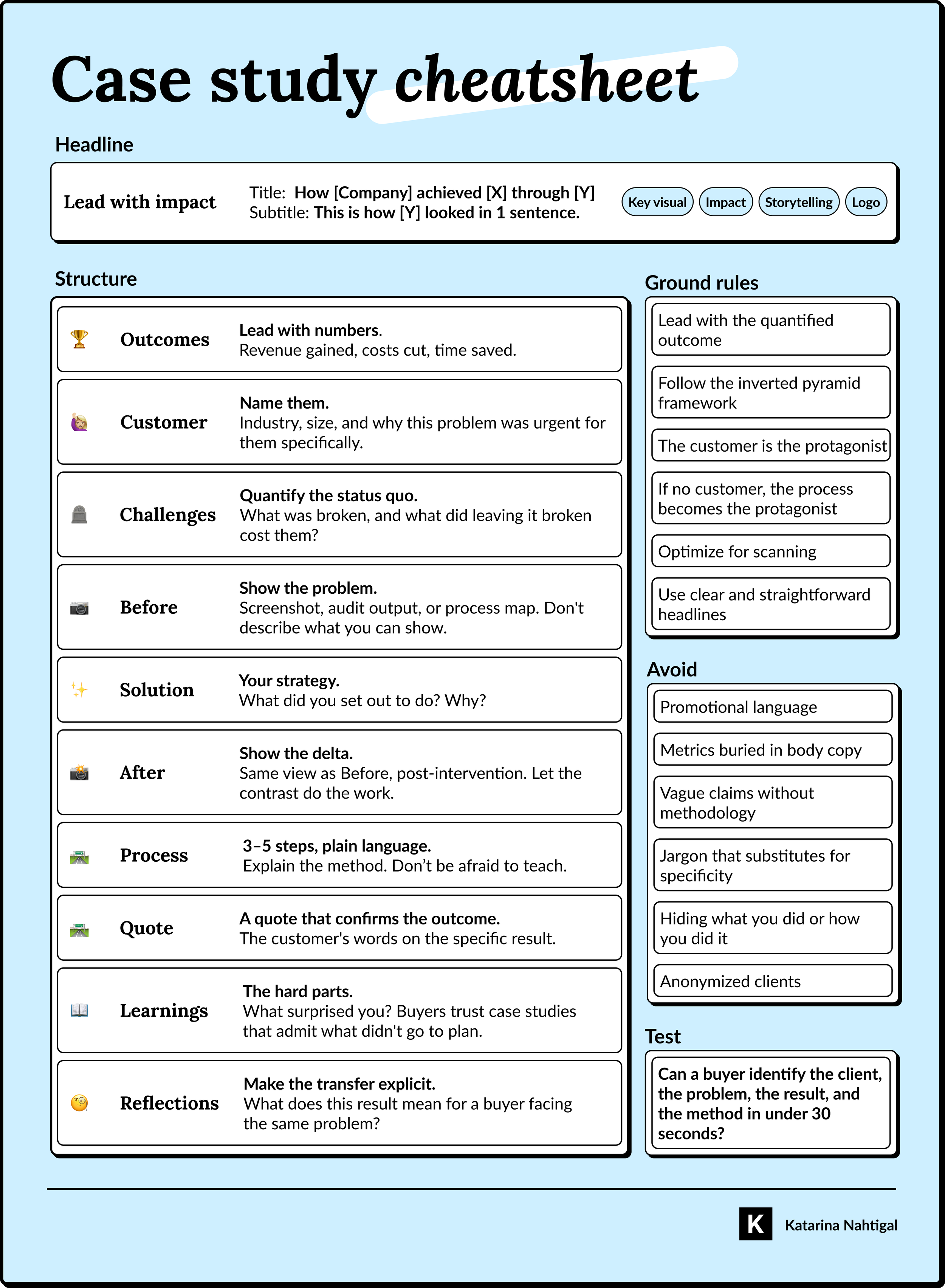
1. Headline: lead with the outcome
A practical formula is:
How [customer] achieved [specific outcome] through [method]
Follow it with a one-sentence subtitle explaining what the work involved.
Avoid headlines such as “A journey of digital transformation”. They sound important while telling the buyer almost nothing.
2. Outcomes: surface the proof immediately
Place the three strongest results near the top. Useful categories include:
revenue gained;
costs reduced;
time saved;
conversion improved;
risk reduced;
capacity increased;
errors prevented.
Every figure needs context. “Conversion increased by 34%” is incomplete unless the reader can understand the baseline, period, sample and what else may have influenced the change.
Use this test for each metric:
From what, to what, over what period, measured where, and attributable to what?
If you cannot answer those questions, qualify the claim rather than pretending the uncertainty is not there.
3. Customer: explain why this problem mattered to them
Name the customer and give only the context needed to understand the stakes: their industry, size, business model, audience or stage of growth.
Do not paste their About page into yours. The buyer is here to understand the project.
4. Challenge: quantify the status quo
Describe what was broken and the consequence of leaving it unresolved.
“The process was inefficient” is vague. “The finance team spent two days each month reconciling invoices across four systems” gives the reader something they can picture and compare with their own situation.
5. Before: show the problem where possible
Use the original screen, audit result, workflow, dashboard, document or customer journey.
Do not describe what you can show.
A before visual also prevents retrospective storytelling. It gives the reader evidence that the starting problem existed in the form you describe.
6. Solution: explain the strategy
State what you set out to do and why. Separate the strategic choice from the list of deliverables.
A redesign, campaign or platform is not a strategy by itself. Explain the reasoning that connected the problem to the chosen action.
7. After: make the contrast visible
Where possible, show the same view after the intervention. Matching before-and-after views reduce the amount of explanation required and help the reader judge the change for themselves.
8. Process: teach the method
Explain the work in three to five meaningful stages. Plain language is more persuasive than a mysterious proprietary framework.
You do not need to disclose every internal technique. But hiding the method entirely makes the result harder to trust. The buyer needs enough information to understand that the outcome came from a considered process rather than luck.
9. Quote: let the customer confirm the specific result
The best quote sounds like a person and adds information. It might reveal what changed internally, what surprised them or why the result mattered.
Avoid quotes that could be placed beneath any supplier’s logo:
> “The team was professional, responsive and a pleasure to work with.”
Pleasant? Certainly. Evidence? Not really.
10. Learnings: include the hard parts
What surprised you? What did not go to plan? What would you change next time?
This section is often removed because somebody worries it makes the company look less competent. In practice, a sensible account of difficulty demonstrates judgement. The project encountered reality, and the team responded.
11. Reflection: make the lesson transferable
End by explaining what the result means for a buyer facing a similar problem. Do not turn this into a closing sales pitch. Help the reader recognise when the same principle may—or may not—apply to them.
What should a finished case study look like?
This is where examples help more than theory.
In the case study kit, I include two finished case studies you can use as references when planning your next one. They show how the same underlying structure can be adapted for different kinds of work: one more commercially driven, one more mission-led and design-focused.
Hop to the case study writing kit →
How can you reuse a case study without flattening it?
One of the reasons case studies are worth doing properly is that they are not one-use content.
A good case study gives you raw material for your website, sales conversations, proposals, social posts, newsletters, presentations and thought leadership. In the age of AI, that reuse becomes much easier—but only if the original story has enough substance.
If the foundation is thin, AI will simply help you produce more thin content, faster. Tiny miracle. Terrible outcome.
If the foundation is strong, reuse becomes genuinely useful because you are not asking every format to invent the evidence from scratch. You already have the customer context, starting point, method, figures, quotes, screenshots and lessons. Each channel can then do a different job.
For example, I often create a longer version for Medium or a blog when the purpose is to educate. That version can go deeper into the method, trade-offs, decision points and lessons another founder or marketer can apply. It is not just “the case study, but longer”. It is where the story becomes more instructive.
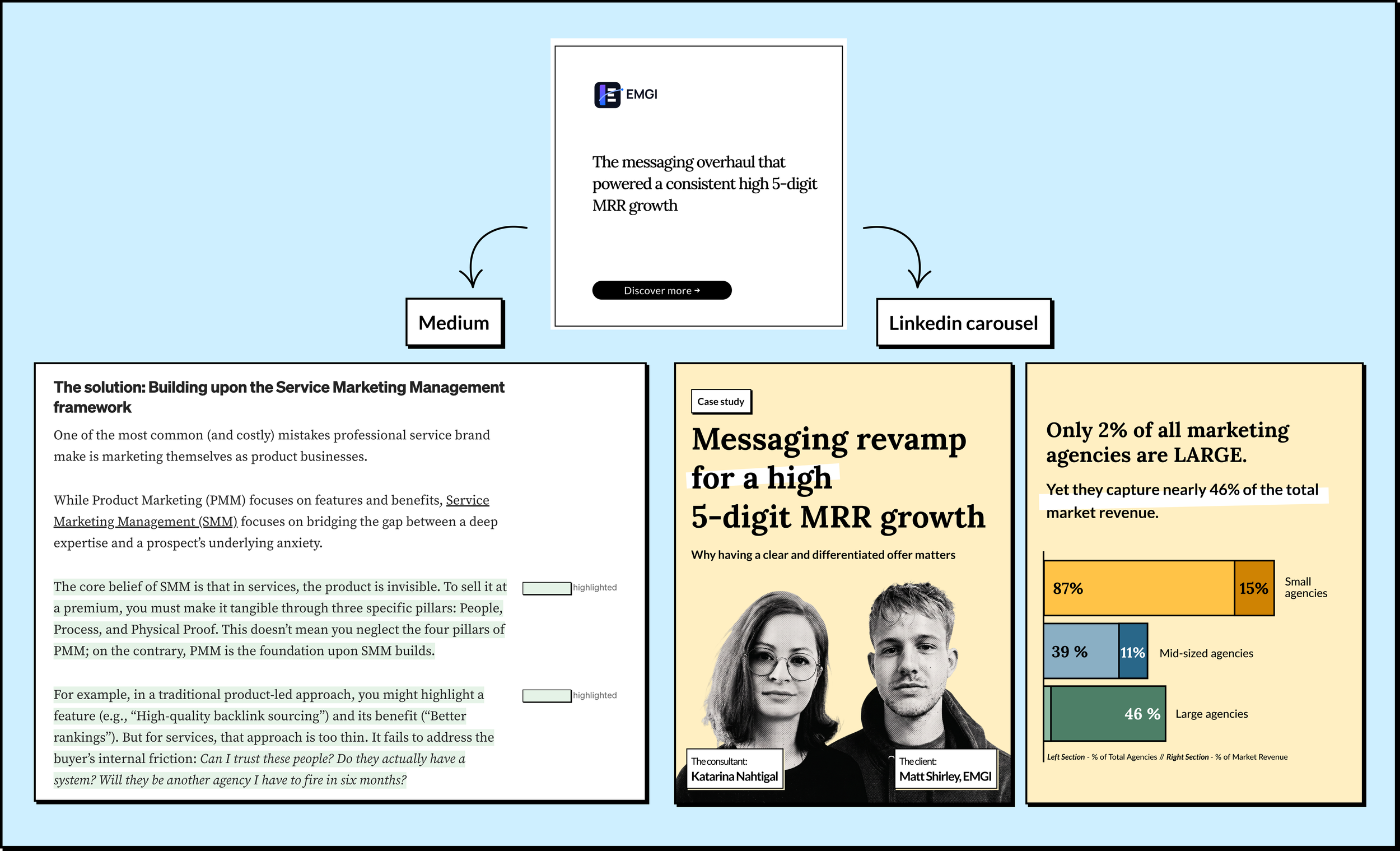
For LinkedIn, I would usually extract the sharpest ideas into a carousel: the headline result, the before state, the one or two decisions that changed the outcome, the most useful metric and the lesson for someone facing the same problem. The reader should not need the full backstory to understand the point.
You can also reuse the same case study as:
a short sales enablement one-pager;
a proposal proof point for a similar prospect;
a newsletter story about the method or lesson;
a webinar or podcast talking point;
a set of quote cards using the customer’s approved words;
a comparison slide showing the before-and-after state;
an FAQ answer for buyers asking whether your approach works in their situation.
The important thing is not to treat reuse as lazy duplication. The same evidence can travel, but the emphasis should change.
On your website, the buyer may want proof.
On Medium, they may want depth.
On LinkedIn, they may want the useful idea quickly.
In a sales deck, they may want reassurance that someone like them has already solved the problem.
This is why the intake and interview process matters so much. You are not only gathering enough information to write one page. You are building a body of evidence that can keep working long after the case study is published.
What should you avoid in a case study?
Before publishing, remove or challenge:
promotional language that the evidence does not support;
important metrics buried in body copy;
percentages without a baseline or time period;
vague claims with no methodology;
jargon used in place of a precise explanation;
a customer who appears only in the title and testimonial (unless they are a big, important company and featuring them gives you enough credibility on its own);
a solution section that lists deliverables but never explains the strategy;
stock imagery where a real artefact could show the work;
anonymous clients when a named example is realistically obtainable (unless your method is so strong and unique it deserves that piece);
a flawless narrative that conceals every difficult decision.
Then run one final test:
Can a buyer identify the customer, problem, result and method in under 30 seconds?
If not, edit the hierarchy before polishing another sentence.
Conclusion: write the case study before you need it
The best case studies are not rescued from memory after the project has ended. They are prepared for while the work is still happening.
That does not mean every project needs to become a public customer story. It means you should build the habit of collecting evidence early: the starting point, the constraints, the decisions, the before-and-after artefacts, the customer’s words and the result that eventually mattered.
When you do that, the case study becomes more than a polite success story. It becomes a useful piece of buyer evidence. It can help a prospect understand whether their problem is similar, whether your method makes sense and whether the result is credible enough to discuss internally.
It also becomes easier to reuse well. A strong foundation can become a website case study, a deeper educational article, a LinkedIn carousel, a sales proof point or a proposal excerpt without forcing you to invent a new story every time.
This is the real work of a case study: not making your company sound impressive, but making the customer’s change understandable.
If you can do that, you have something much more useful than content.
You have proof.
FAQs
-
A B2B case study helps a prospective buyer evaluate risk by showing how a real customer addressed a comparable problem, what approach was used and what changed. It is most useful during vendor evaluation, when buyers need relevant proof they can share with colleagues.
-
Lead with the outcome, then cover the customer, challenge, before state, solution, after state, process, customer quote, learnings and transferable lesson. The customer should remain the protagonist throughout.
-
Specific context, verifiable results, a clear method, named participants and candid customer language make a case study persuasive. Slick design cannot compensate for weak evidence, but it does go a long way.
-
Yes, whenever possible.
-
It can, but anonymity reduces credibility and makes relevance harder to judge. If the customer cannot be named, provide specific industry, scale, problem, process and measurement details without exposing confidential information.
-
Interview the person who experienced the problem, participated in the decision or can explain the business result. Ideally, speak to both a senior stakeholder and someone close to implementation; their perspectives answer different buyer questions.
